2008年1月9日号 The Business Times(シンガポールの英字紙)
On current trend, the seniors market here holds promise
By ANNA TEO
[SINGAPORE] For someone who’s regarded as an opinion leader on ageing issues in Japan and has written several books on the silver industry, Hiroyuki Murata hasn’t exactly “been there, done that” himself.
After all, at age 45, he’s at the trailing edge of the Baby Boomers – the iconic group that entrepreneurs and marketers have belatedly identified as the hot consumer market segment to pursue for their spending power (or prowess).
But he did coin the term “active seniors” in Japan back in 1999, when the Japanese government offered long-term healthcare insurance for those in need of nursing or home-care and it was found that only 20 per cent of those above 60 years needed such care.
“This means that 80 per cent of the people above 60 years did not need the medical care at the moment; they’re very active. That’s why I started to advocate my business target to be the group I call ‘active seniors’,” he told BT in a telephone interview from Japan. “After that, many Japanese companies followed and used the term.”
Mr. Murata, an entrepreneur and business incubator of sorts, then created the Smart Senior Consortium of some 30 firms – including NTT DoCoMo, Tokyo Electric Power Co and advertising agencies – with the goal of creating business in Japan’s 50-plus market.
Tepco, the electric utility, went on to develop housing for retirees, while NTT DoCoMo started a range of “incredibly sophisticated” easy-to-use Raku Raku mobile phones aimed at older folks, with big buttons and displays, read-aloud features and even a pedometer. More than 10 million sets of the phone – which can also reduce voice aped for better clarity – have since been sold.
“This is one very good business. NTT DoCoMo has the special technology, market and product design. They heard the consumers’ voice,” said Mr. Murata, who went on to start up Murata Associates in 2002.
If SingTel introduces a similar user-friendly cell-phone, their will be a big market not only in Singapore but also in the neighboring countries, he reckons.
Previously, people saw in the silver industry perhaps only the nursing and home-care sectors, he said.
“After I started Smart Seniors Consortium, many companies noted the big opportunities in other industries for people above 60 years.”
Describing Murata Associates as a “new business-creating company”, he said: “I’m not a management consultant. My job is to create new ideas, combine different technologies and consumer needs, and present them as opportunities to companies that want to create new business. We’re like an incubator, but much more than an incubator.”
Now a regular speaker at international conferences on ageing in the United States, Mr. Murata is in town this week for the Silver Industry Conference and Exhibition (SICEX), where hi will talk about how Japan turned one of its demographic inevitable – ageing into a business.
“The business is created by the voice of consumers – the market potential is there. Next is the product seed – that’s technology and frontier research. And then you need ideas – planning and marketing.”
He lists housing, travel and communications as the biggest growth industries for the seniors market.
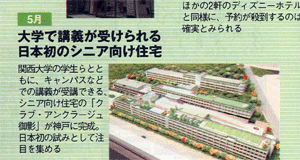
And housing for older folks need not become isolated geriatric villages. He himself is involved in a housing project in Kobe, opening in May that will have a few hundred retirees in a community linked to a nearby university so that they can continue to learn and interact with young people.
In Japan, people above 50 years of age own 70 per cent of the country’s total personal financial assets, he noted. “The proportion is the same as in the US. It’s the same everywhere.”
With one in five residents due to be 65 years or older come 2030, Singapore recognizes the silver industry’s economic and business potential. But ageism is rife here, and not just at the workplace.
“Mindsets need to be changed,” said retired lawyer Wong Meng Meng, chairman of the SICEX organizing committee. Society needs to recognize not only that there will be a lot more senior folks around, but also that many of them remain highly productive and socially active.
To this end, SICEX will feature not only healthcare and wellness, travel and leisure options, but also how to finance a long life and enhance it with technology.